

Introducing Checkout 2.0: A Conversion Optimized Checkout for DTC at Scale


Introducing Checkout 2.0 - Appcharge’s most advanced checkout yet.
It’s a conversion-optimized, game-native checkout designed to adapt to players, payments, and the realities of running DTC at scale.
When teams talk about why DTC underperforms, the focus usually lands on acquisition, pricing, or offers. In practice, we’ve seen something else consistently break first: checkout.
Checkout is the moment of highest intent and lowest tolerance for friction. It’s where small UX decisions, payment logic, and operational gaps quietly compound into real revenue loss. And yet, many teams still treat checkout as something you wire up once and move on from.
After working with publishers processing hundreds of millions of dollars in DTC transactions, we’ve learned the opposite is true:
Checkout isn’t an endpoint. It’s a live system. That belief is what led us to rebuild Appcharge Checkout from the ground up.
Why generic checkout assumptions break in mobile games
Most checkout infrastructure was designed for ecommerce. Mobile games behave very differently. Players are context-switching mid-session. They’re buying from different regions, on different devices, with different payment habits. Some are making their very first purchase. Others are returning buyers who just want to get back to gameplay as quickly as possible.
When you apply a one-size-fits-all checkout flow to that reality, three things tend to happen:
- Drop-off at peak intent becomes disproportionately expensive
- Too many payment choices increase hesitation instead of confidence
- Payments, fraud, compliance, and UX become operational silos that don’t scale well together
The checkout technically works. But it leaks revenue.
Treating checkout as a product, not a static page
Over time, we realized most checkout problems aren’t caused by missing features. They’re caused by the wrong design assumptions.
Instead of exposing numerous payment options at once, Checkout 2.0 prioritizes the few methods most likely to succeed for that specific player.
Instead of static flows, Checkout 2.0 screens adapt based on concrete signals like region, device, operating system, payment history, and whether this is a first or repeat purchase.
And instead of optimizing only for headline conversion rates, Checkout 2.0 is designed as part of a broader system that directly affects fraud, disputes, and net revenue at scale.
This is the philosophy behind the new Appcharge Checkout.
A faster, game-native checkout experience
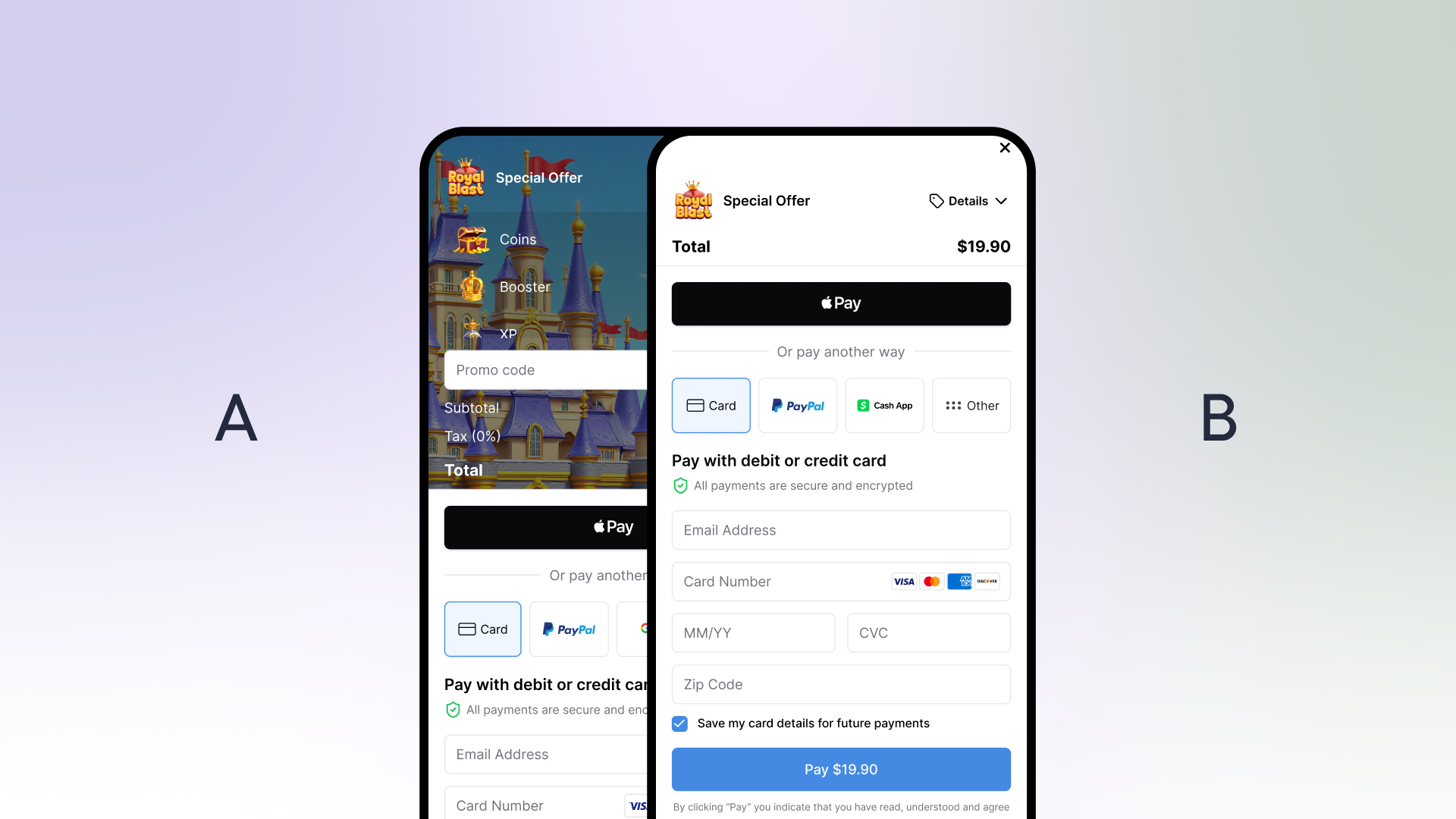
Checkout 2.0 is designed to feel like part of the game, not a foreign web layer.
Layouts are streamlined, load times are optimized, and details most generic checkouts ignore are handled deliberately - including support for landscape mode, so the checkout experience mirrors the actual in-game UI on iOS and Android.
Built-in A/B testing and redundancy allow layouts and flows to be continuously optimized over time, without requiring publishers to run their own experiments or dedicate engineering resources to payment UX.
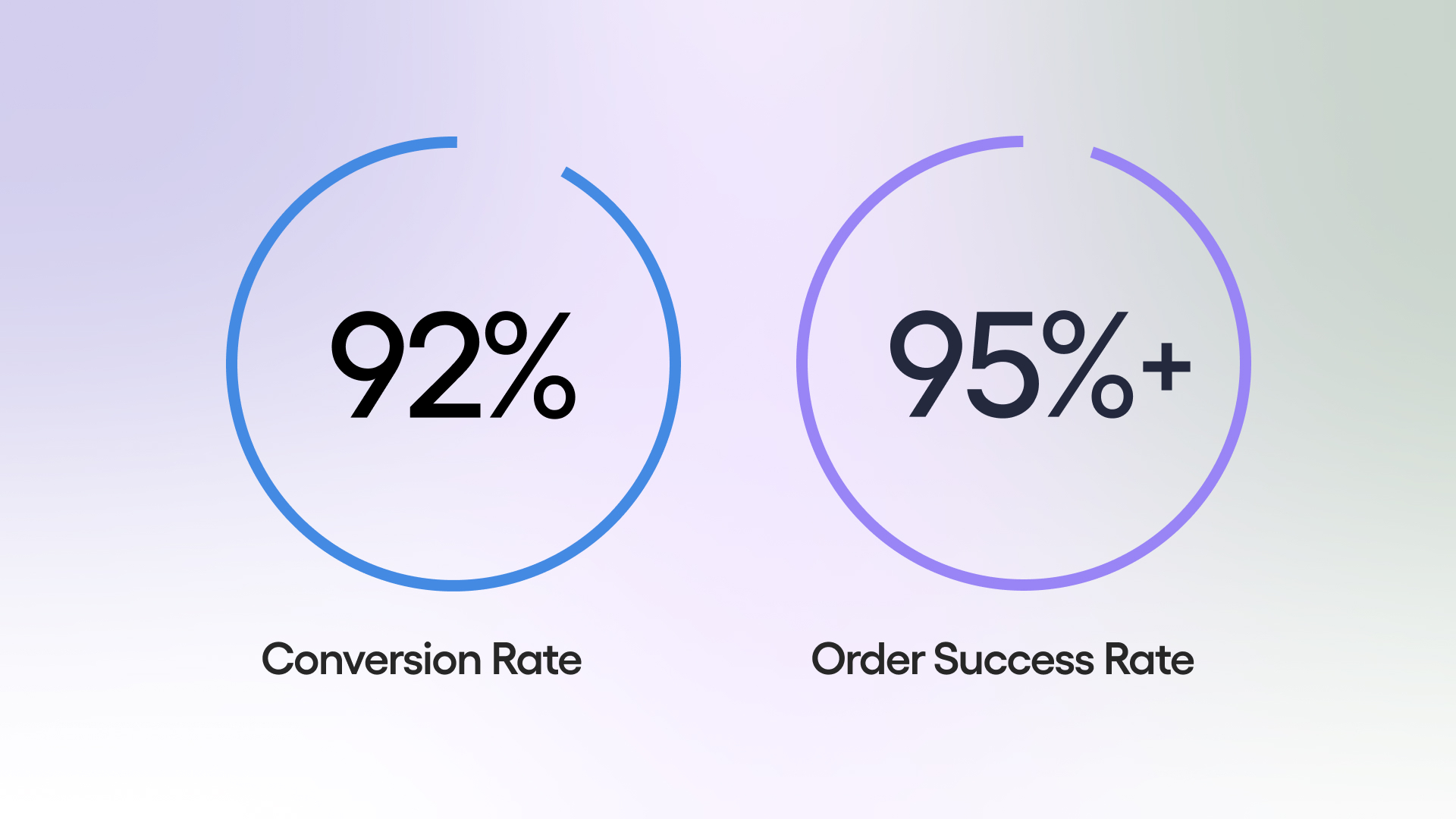
In live environments, this approach delivers conversion rates of up to 92 percent.
Player-level personalization that reduces friction
Every Checkout 2.0 session adapts to who the player is and how they’ve paid before. That includes:
- Country and currency
- Device and operating system
- First-time versus returning buyer status
- Preferred payment methods and payment history
- Game genre
For repeat buyers, Checkout 2.0 reduces friction with optimized views and one-click payment flows.
For first-time buyers, layouts are designed to build trust, minimize hesitation, and make the initial purchase as effortless as possible.
This kind of personalization isn’t cosmetic. It directly impacts purchase completion.
Smarter payment method presentation
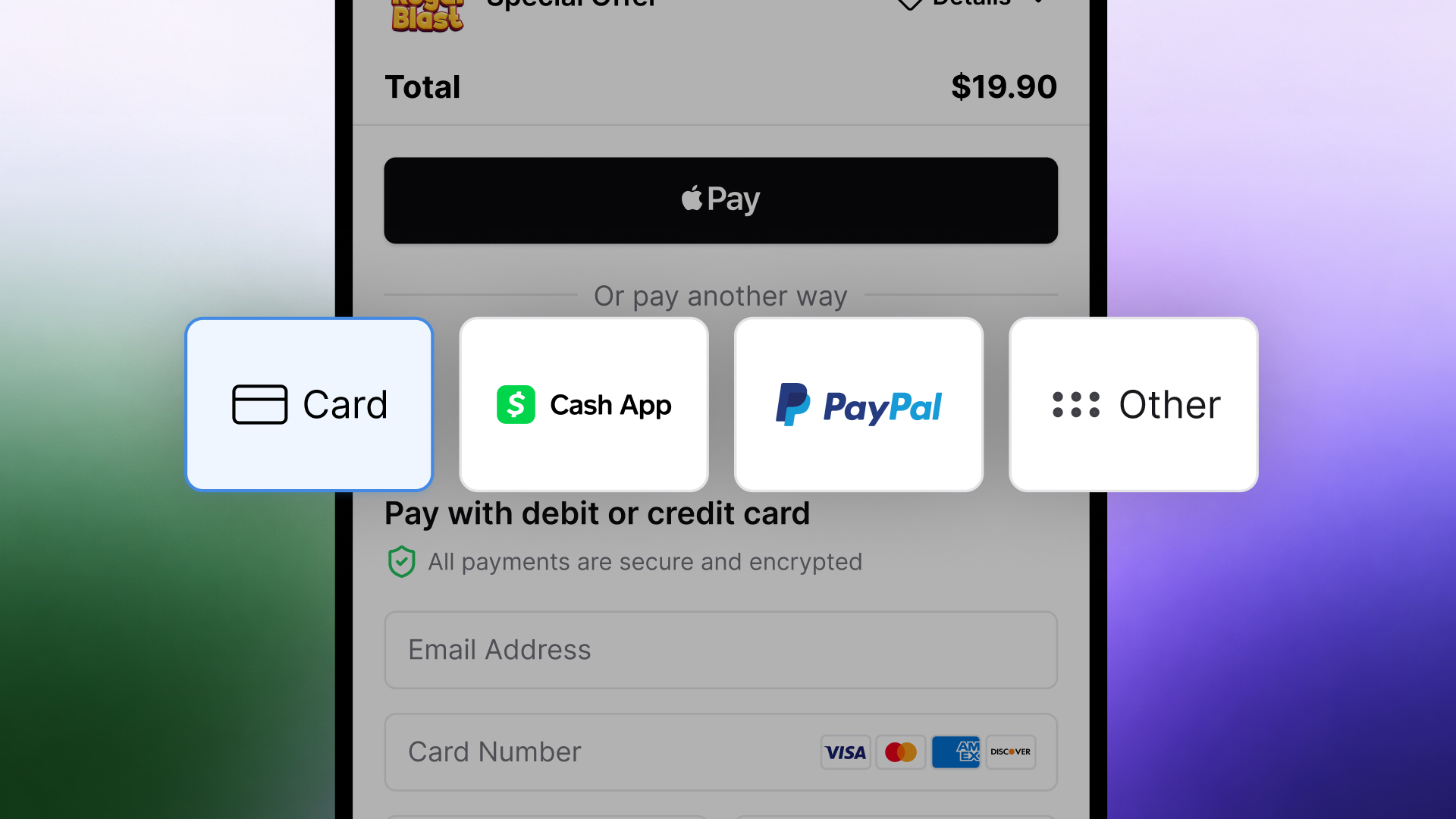
Supporting hundreds of payment methods doesn’t help if players are forced to choose between all of them.
Appcharge Checkout 2.0 supports a large number of local payment methods, but automatically prioritizes and surfaces only the most relevant options for each player.
Visual noise is reduced, components are cleaner, and returning users are guided back to their last successful payment method. Combined with smart routing and failed-payment recovery, this results in order success rates exceeding 95 percent.
Conversion is only half the revenue story
Headline conversion rates don’t tell you how much revenue you actually keep. At scale, net revenue is shaped by what happens after the click: failed payments, retries, fraud, disputes, refunds, and local tax exposure.
This becomes especially visible once DTC expands beyond a single market. In our January 2026 DTC report, based on $700M in annual transactions, we saw how fragmented payments become at scale.
In the U.S., roughly 25% of web store payments are made using methods other than credit cards or Apple and Google wallets. In Europe, that share grows further, with nearly 1/3 of purchases relying on alternative or country-specific methods.
At scale, those “non-default” payments aren’t edge cases. They represent millions in annual revenue, each introducing different settlement characteristics, dispute handling requirements, fraud exposure, and regulatory considerations across markets.
That’s why Checkout 2.0 is delivered as part of Appcharge’s end-to-end Merchant of Record platform. We handle local entities, taxes, currency conversion, fraud mitigation, dispute management, and 24/7 player support on behalf of publishers.
That includes dispute win rates of 60–70%, compared to typical industry benchmarks closer to 30–40%. The result isn’t just better checkout metrics. It’s materially higher retained revenue.
Built to integrate quickly, and scale safely

A powerful checkout isn’t useful if it’s painful to adopt.
The new Checkout gives publishers full control and supports multiple integration paths: native SDKs, hosted payment links, web SDKs, and headless APIs. Built-in fallback mechanisms allow safe recovery between embedded and link-out flows, while compliance requirements are handled by default.
For most teams, integration is faster, lighter, and significantly lower overhead than maintaining an in-house system.
Where checkout is heading
As DTC becomes a core revenue channel, we’re seeing a clear shift among leading publishers. Checkout ownership is moving from “done” to ongoing; from static implementation to continuous optimization; from generic payment infrastructure to systems built specifically for games.
The new Appcharge Checkout reflects that shift. Because in DTC, the most expensive page in your funnel is the one you stop paying attention to.


